Hotel the Exchange – Amsterdam’s new creative nest

Left side is the OPTIONS! design store from Hotel the Exchange.

Lloyd hotel’s second endeavor, Hotel the Exchange, has recently opened its door in the center of Amsterdam. It’s literally located in the center that is notorious for its touristic café, snack bars, restaurants and souvenir shops. Many locals tend to avoid this hasty & noisy tourists’ spot, though it does have very special charm of quirkiness. Besides those low-profile hotels, there are many hidden surprises such as rooftop sauna, introverted restaurants (without street entrance) and many abandoned-, vacant- upper floor spaces waiting for the future to come.

In the past, there have been many attempts trying to intervene this area or to activate these vacant floors, but the long-term procedure (resulted from the urban legislation, the monumental law and etc.) has discouraged many initiatives. So how did Lloyd Hotel make Hotel the Exchange happen within half an year?

The first Lloyd Hotel is transformed from a former emigrant hotel, successfully creating a new cultural spot by mixing a design hotel with event spaces. Then Lloyd has launched a temporary hotel in Tokyo – Llove Hotel. After these challenges, Lloyd Hotel’s next ambition is to be the cultural catalyst for not only a marginal neighborhood and abroad, but also for the center of Amsterdam. So they acquired the second property without any hesitation when those 3 buildings on Damrak became available.

A snapshot from google map showing the former Damrak hotel and the building front were covered by signs and winter gardens.

The facade of the 3 buildings are refreshed by Hotel the Exchange, with higher ground floor spaces.

It seems impossible to connect 3 historical buildings into one (which is in conflict with the monumental law), but the possibility has been quitely created by the history. First of all, these 3 different-looking buildings, have actually already been connected by the former owner to create 2 hotels. This explains why Hotel the Exchange could be undertaken within a rather short period of time – without going through the process of negotiating with the monumental law and of changing the destination of use (e.g. from ‘housing’ to ‘hotel’). Another possibility created by the history is the entrance hallway – a ‘shaft of light’ that allows daylight to fall into this narrow corridor next to a snack bar. Tracing back to the historical drawings, it has been found out that there used to be an alleyway in the 17th century, which has been ‘swallowed’ by the building later. So eventually the city is happy to see the alleyway brought back by Hotel the Exchange.

Entrance is next to a snack bar.

In the light shaft looking towards the entrance - this was used to be an alleyway before.

Hotel the Exchange has created 61 rooms, café STOCK and one design store OPTIONS! all within 3 small building blocks. The arrangement of the rooms were mostly adapted from the 2 former hotels, though the interior has become more ‘porous’ by removing some rooms and creating internal windows. Other than most of the low-budget hotels that tend to block the views towards outside, Hotel the Exchange has revealed the views to Damrak as well as to the inner courtyard. Both views exposed more chaos rather than romance of the city, but have allowed spectators to reality-check the center of Amsterdam, which has been decaying and is now asking for more attentions and creative solutions to re-generate.

Hotel the Exchange has brought back the double height ground floor space in order to create Stock café.

Inside the OPTIONS! design store.

So will Hotel the Exchange be the catalyst for change for Amsterdam’s center? And how? It is clear that they are spreading slowly the spider web in this area…we will not have to wait for too long to hear Lloyd’s next surprises!

//////////

I’ve like to thank Lloyd Hotel who shared their experiences and offered me a great guided tour through their buildings. Above story is based on the interview with Suzanne Oxenaar, who together with Otto Nan have initiated Lloyd Hotel, Llove Hotel & Hotel the Exchange.

Pop-up! Temporary use of niche spaces

In the last post Pop-up! Creative use of niche spaces #2 I have shared some cases of shared storefronts, collaborative shops and temporary use spotted in Taiwan. Those urban happenings are interesting though often motivated by short term profits. Here I’d like to share some international cases that have more longer-term impacts on the use of urban niche spaces:

////// Restaurant Day, Helsinki ////// A day for anyone to start up a guerrilla restaurant

Image by jonnatammisto

Restaurant Day is a food carnival in Helsinki when anyone can open a restaurant for a day, and the best of all is – no permits needed! Imagine that you can order a sandwich that is served in a basket, lowering down from a 3rd floor apartment window?

Image by jonnatammisto

The 4th pop-up restaurant day was just celebrated on February 4th 2012. It has been a success because it encouraged everyone to be creative in making food (which most people like to do), making a one day business (with lots of fun) and turning a home or a street into a restaurant (like a carnival). As described in The Pop-up City:

…a Forager Baker kitchen where everyone could make their own pizza from fresh picked ingredients in a stone oven and a Soup King serving soup and advising its customers to buy plates in the nearby flea. Restaurant Day was organised through a Facebook event and food was literally popping everywhere; in the streets, parks, clothing shops as well as Helsinki homes.
It’s interesting to see how this experiment keeps encouraging more fresh restaurant concepts, and how the urban regulation will react to this informal initiative. To get more impressions of Restaurant Day you can check this Flickr album

////// Meanwhile Space ////// Connecting temporary users to vacant properties

image source: http://www.meanwhilespace.com

Meanwhile Space connects temporary users (e.g. artists, start-up entrepreneurs or charities) to landlords with available spaces, in which temporary leases are organized. As described Meanwhile Space’s mission:

Meanwhile Space works with landlords, landowners, developers and local authorities to relieve them temporarily of liabilities (insurance, rates, security etc.) associated with holding redundant shops, offices, cleared land etc. whilst an appropriate commercial solution is being sought. By working with local communities and other stakeholders, interim or ‘Meanwhile,’ uses are deployed to reanimate the space and provide opportunities for community benefit and social enterprise.

This creates mutual benefit for both the vacant property owners and the temporary users who, on the one side can finally release their frozen properties, and on the other side can finally afford spaces to start up. On Meanwhile space’s website you can find practical resources / handbooks that describe how Meanwhile Lease works for both the landlords & users.

One of their initiatives is using a former Subway shop in Exmouth Market in London, which has already hosted many projects from an exhibition space (The Pallet Project during Clerkenwell Design Week), a vintage clothing shop (Harry’s smile) to a cake shop (Roving Chef).

The former Subway shop has been vacant for two years before Meanwhile Space re-activate it.

Launch of The Pallet Project. Images by Robyn-Louise Simms, New Deal of the Mind

Roving Chef - a one-week cake shop at the end of August, 2011.

Click this Meanwhile Space Forum to see more images of these projects.

////// REC, Igualada ////// 3-days event that turns a village into a fashion outlet

Preparation of the pop-up shop Desigual at REC store. Image source: www.recstores.com

REC claims itself as ‘experimental store’ by transforming old factories in the village Igualada into pop-up shops, where the emerging design brands offer their stock at incredible (affordable) prices. What makes this initiative exciting is the choice of location – a decaying town that has a long tradition of tanning and textile industries. This event thus connects the locals, physically and mentally, back to their industrial heritage & tradition.

The following video shows the first edition of REC.01, giving an impression of Igualada and the process of reviving abandoned buildings:

The REC.05 is going to celebrate its 5th edition during June 6-8, 2012. Click this google map to browse the route of this year.

Pop-up! Creative use of niche spaces #2

In 2011, I have posted an article with the same title. Together with another article Rent A Shelf and start up a collaborative pop-up shop, they were the most visited posts last year. In 2012, I’d like to look at the term Pop-up not only from the trendy retailing examples but also those improvisational, informal and temporary cases spotted in Taiwan.

////// case one ////// sharing shop spaces or occupying pedestrian area //////
In Taiwanese urban context, sharing spaces is actually triggered by many private shop renters who use the space to make extra profit. Imagine a retail shop owner who rents a space for 1000 euro/ month, and then share the shop space with other two sub-renters who pay 500 euro/ month each. In this way, they share the initial investment & risks, and could possibly attract more customers.

In Taipei: two food vendors share one storefront.

The idea to generate more income is so attractive that many shop renters even claim the pedestrian zone and rent them to other street food venders. In the picture below you can see: the shop owner has moved out to become the street vendor (where the red arrow is pointing), in order to rent the storefront to another shop. He even rents out the pedestrian zone to another street food vender.

You can see the shop owner occupies the left corner outside of the storefront, and another food vender rents the pedestrian zone in front of the shop.

Occupy the pedestrian zone.

In the picture above, you can see the owner of the convenient store (which opens 24 hours) has also rented the pedestrian zone to other vendors during the day.

The above mentioned examples actually get media attention only when they are being spotted as illegal business, and are considered as planning defect. Though on the other hand, they have created shared value by intensifying the use of the space.

////// case two ////// pop-up sales and temporary stores in vacant spaces ////////
Far before Pop-up has become a trend, there were already temporary shops filling up the vacant retail stores in the cities. This kind of pop-up stores, or temporary outlets were emerged out of an economic situation: in the time of bad economy, retailers could save money on interior decoration and quickly clear their stock; property owners could profit from short-term tenants rather than leaving the space vacant.

Picture source: urbanphoto.net, by K.Y. Cheng

One of Urbanphoto’s article, Temporary Stores Thrive as Others Fade, has looked at this kind of temporary shops in the context of Hong Kong:

“Since many retailers signed contracts at the top of the market one or two years ago, rents remain high and so does the potential for bankruptcy. When shops go out of business, landlords are faced with a few options: bide their time by keeping the space empty, slash rents, or play host to a temporary store that will help them cover costs until they find a new permanent tenant.”

////// case 3 ////// social selling and the collaborative shop //////
A recent article in The Pop-up city has mentioned Social Selling, predicting that it will become a growing trend in 2012. In Taiwan, social selling or in another word collaborative shop, has been always a reality. Just around the corner of my parents’ apartment in Taipei, I’ve spotted a tea shop (1m x 1m space) nested in a bike store.

For a start-up business, a small-, affordable- space at a prominent location is all that it needs. For many online business, renting a small space together with others as a show point or just popping up at various locations – seem to be more effective than occupying a big high-street storefront. It’s exciting to see this happening in world-wide cities – private initiatives and non-profit organizations are starting to share retail, working or restaurant spaces. By making the spaces more shareable for multiple, mixed or temporary use, the value of spaces can thus be intensified and multiplied.

In my next post, I’ll share some international cases where collaborative shops are created with more social or non-for-profit approaches.

Ending note: I’d like to thank Boundary Unlimited who has inspired me a lot about Asian informal urban development and brought my interest back to my own Taiwanese urban experience.

The nest of The Mouse Mansion (Het Muizenhuis)

I’d love to share this winter wonder with you for this specific moment of the year.
/////////////////////////
It was an year ago, around the same period of Christmas holidays, that this installation The Mouse Mansion (Het Muizenhuis) popped up in the window of my neighbor’s house. Its surprising presence has surely created a new attraction in my neighborhood. Everyday curious crowds hung in front of the window; kids especially excitedly stuck their faces on the glass and crawled up and down of their parents in order to see every corner of this miniature house.

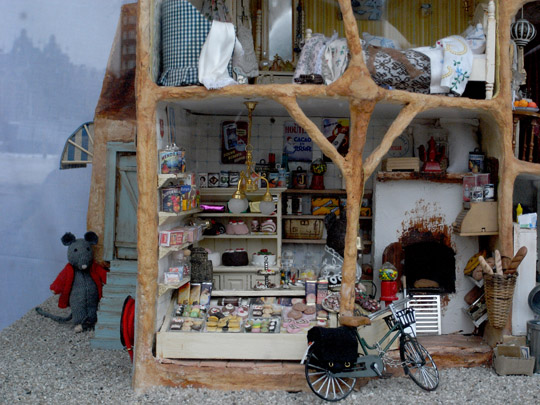
Well, the surprise is not just for the kids. I was also amazed after giving it a close look – these mice poppets, the miniature house, the furnishing of the house, the bathroom fixtures and the kitchenware…etc., every detail of this miniature house is crafted all by an artist,

The making of:
From the picture above, you can see that these water vases are actually made of paper!


An impression on the structure of the house before we get closer to look into the rooms…


The wall paper and all those blankets on the shelves…


The candle holder on the wall (right side)…


The tiles in the bathroom, the weighter, and the garbage bag next to the trash can…


The lady’s corner…


Bakery and the delicatessen…of course, the bycicle! These are mice in the Netherlands!


This is my favorite, Oliebollen street vendor – Oliebollen is a bit like donuts (fried dough) a traditional Dutch treat for December.


This window is located at Weesperzijde adjacent to the river Amstel. There are some café restaurants next to it. Beyond the event days, it’s just a domestic / and transit route. During the month when The Mouse Mansion was nested, the anonymous window has created a new point of interest. Since then, I see more often that these kind of temporary window gallery popping up in my neighborhood.

Though this year, The Mouse Mansion has found a permanent nest at OBA (Amsterdam Public Library), so I’m not able to say hello to these mice everyday anymore.

Now this book is lying everywhere in the bookstores in Amsterdam, and of course now it’s also in my book shelf. Though The Mouse Mansion will not come back to my neighbor’s window, I’ll have a cozy winter with the book accompany me.

Check the official blog of The Mouse Mansion / Het Muizenhuis.
http://the-mouse-mansion.blogspot.com (in English)
http://hetmuizenhuis.blogspot.com (in Dutch)

News release: boxXshop

The official flyer

boxXshop is a very special 180 minutes Christmas market on the 1th of December inside Lloyd Hotel Amsterdam. 30 gift shops with great variety will pop-up and bring you limited edition handmade gifts for Sinterklaas and Christmas.

30 artists, makers and designers will offer you diverse Christmas gifts.

This is a collaborative pop-up shop with 30 artists, makers and designers, who will offer you diverse goods ranging from jewelry, paper and craft, ceramics and pottery, delicatessen, crochet, to knitting. No commercial products; only personal cultures…and all presented in 40 different boxes. So where are these boxes from? They are boxes from Lloyd Hotel’s library! Together we will install the boxXshop 2 hours prior to the event; after the event, all the boxes will be re-installed as the library. #Cradle-to-cradle!

boxXshop is the place to be for you who fancy an alternative Christmas market, and who want to enjoying shopping and a delightful Thursday evening in a cozy place. You can find us on December 1, Thursday shopping night at Lloyd Hotel. We will be there from 6-9pm…See you then!? Oh, and don’t forget to bring your cash!

This event is created together by Lloyd Hotel & Cultural Embassy and Nest Project.
You can also get an impression of our event by watching this video or the photos.

Rent A Shelf and start up a collaborative pop-up shop

In my previous post about space sharing, I’ve mentioned the idea of flexible ownerships of a shop space; for example, anyone can sell/ promote products on a shop’s wall. It is a growing retail store concept – instead of investing a shop space by one’s own, more and more artists, designers and start-up retailers are investing together and become ‘temporary co-owners’ of a shop. This new trend of Owning a Shop Together not only helps the small, start-up retailers to invest less, but also creates great product varieties for the customers.

Onedayshop in Amsterdam. image source: popupcity.net

For example, Onedayshop is a furnished ‘vacant’ retail space open for short-term (1 day – 1 week) lease. A recent post by Pop-up city says:
For customers this initiative is great to test a brand’s products and to find out whether it would be a good idea to rent a shop on their own. Like with exhibitions, the opening party is the best moment to sell creative products, as the artist’s own network is present at that moment.

Here I’d like to share with you three other interesting retailing stores around the world. They are not necessarily representative; but they have all tried to create marketplaces that effectively connect individual sellers & buyers together. These are emerging retail spaces that are collaboratively run by individual sellers / temporary shop owners.

1. Tokyo Pass The Baton Vintage Shop:

Shop space of Pass The Baton in Omotesando, Tokyo.

Launched with an opening party together with an online webshop, some say it’s the best second-hand store of the world with a statement:

The modern marketplace contains a vast diversity of commercial products…….creating something new is a wonderful thing, but taking good care of an object that is already there can be magical.
Pass on your personal culture.
It’s a new way of recycling.

At Pass The Baton, you’ll find Items for sale presented not only by images, but also by a brief profile of the seller. Beyond the flea markets, this is a marketplace both physical and online for buyers and sellers to exchange their ‘personal culture’.

2. Singapore CACTUS Farm:
This is a good business model of boxXshop – as I have mentioned many times in my previous posts – a concept that prevails many Asian cities including Tokyo, Shanghai, Hong Kong and Taipei. It’s slogan: ‘get a prime location for $5.00 a day!’

Cactus cubic shop in Singapore.

For young designers, Cactus Farm an affordable and fully serviced retail space in a shopping mall to showcase their ideas and products. Together with other temporary co-owners, you can rent a cubic space for a reasonable fee (and for a short time) to test the market of your product!

3. Muenster / Munich Rent-a-shelf:
I came across this article ‘Rent-a-shelf: a new way to sell and advertise – including yourself’ that tells the new trend of Rent-a-shelf in Germany which was spotted by Pop-up city (yes, again!). I’m sure that there are more examples of Rent-a-shelf around the world, since it’s a more spontaneous action and might not be properly documented. Anyway, what’s interesting in this article, is about a young man who withdrew from facebook and rented a shelf in a shop to advertise himself as an available single. Do check this article which contains some good thoughts and interviews about these space-sharing initiatives in Germany. As the article says:

A simple shelf in a small store is really all a person needs to advertise and sell their products and services…
If you have a shop and would like to generate more flows and curiosities, why not share your shelf and create a collaborative pop-up shelf shop?

My space is also Your space: Space Sharing

This morning I came across the blog collaborative consumption (manifested as ‘What’s mine is Yours’) then I have chatted with a friend about P2P sharing cars, and besides I’m busy with pop-up store by using available boxes at Lloyd Hotel.

We will borrow these boxes from Lloyd Hotel

These seem like random topics but they all shake up the way we think about ownerships.

Gradually, we are creating new values to exchange services or properties – besides money. These days, more and more new initiatives are enabling everyone to share available resources with the others, and turning My properties into Our properties: examples like share un-used cars (ex. LiftShare), share spare spaces at home (ex. AirBnB), share vacant desks in the office (ex. deskwanted) or simply share working space together (ex. The Hub).

New off-line marketplaces or on-line platforms are stimulating flexible ownerships, and creating new opportunities by sharing. One interesting reference is this infographic: the Collaborative Home, posted by FastCo Design, reporting all the spared things you can share from home:

image source: FastCo Design

This flexible ownership of properties, is one of the major inspirations behind the initiative of pop-up store boxXshop. This is also what Nest Project aims to do – mobilize individual makers of arts and crafts by connecting them to available spaces. There are plenty of spaces left vacant or available to share in our cities. With the current web technology and mobile phone applications, it’s possible to enable any individual to launch a pop-up store spontaneously. Imagine that a shop owner can tag a piece of sharable space, such as a piece of wall. So people who received this push notification can walk in this shop and say “hi I want to sell this, can I hang it on the wall??”

Further reading:
1. Pop-Up Coworking: A Way To Work Anywhere (with interesting photos), published by Shareable.
2. Home-Sharing Programs Offer Longer-Term Housing Solutions, published by Shareable.
3. I have started to collect some examples of marketplaces & platforms that enable individuals to connect their available sources (time, properties, services) to others that need them. Let me know if you know other interesting marketplaces & platforms. I’d like to keep collecting this information and share with you at Pinterest!

Pop-up! Creative use of urban niche spaces

With this post, I hope to give an impression on the current trend of pop-up initiatives who turn urban niche spaces into temporary attractions. Here you can find international initiatives that take ‘nomadic’ as a strategy (such as Comme des Garçons). You can also discover projects that initiate time-share to intensify the use of space (such as Mission Chinese Food). It is worth-noting that many of them rely with social media (twitter, facebook, RSS…) which keeps their followers/ fans updated about the next surprising event/ location.

////////// Nomadic //////////

Comme des Garçons is the pioneering example of pop-up shops. Launched at unremarkable locations in Berlin/ Glasgow/ Reykjavik/ Helsinki/ Singapore and just to name a few – it has attracted curious crowds by the fusion of high-end fashion brand and the low-tech interior space. The picture above shows a recent pop-up store in Warsaw that has transformed a former fruit and vegetable store in to a temporary retail shop.

image source http://hypebeast.com

Henrik Vibskov – the danish designer launched ‘The 100 days store’ in SPRMRKT Amsterdam, as the first stop for his traveling fashion show/ retail store. Traveling around the major European capitals, each store will be an experiment with spaces and installations. Here you can find an interview about the designer and his initiative.

Henrik Vibskov's Travelling Store

image source http://blog.henrikvibskovboutique.com

Continue reading

China Tea Jelly Town

Chinatown Tea Festival 2009, September 26th, various locations on the Geldersekade, Amsterdam

Delicious jelly buildings are for sale! A food model concept was introduced by two Taiwanese born Amsterdam based architects, Tsaijer Cheng and Changfang Luo , on the Gelderlsekade for the Chinatwon Tea Festival 2009. Jelly buildings made out of 4 tea flavors: including Glodenblossem, Greentea, Rosella, and Blueberry, represented diverse shops and houses on the Zeedijk and the Geldelsekade. Public were invited to buy and eat their own building property for 50 euro cent to purchase their ideal building locations in the Chinatown area.
The concept of the young architects is to invite the public to think about the future urban potentials of the Chinatown area, with the rich mix of culture and nationalities, a neighborhood of diversity can be enhanced through introducing different shops or functions to Zeedjik and the Geldersekade.